

Omaha • Lincoln • Council Bluffs
Restroom Trailers for
Weddings and Corporate Events.
Flushing toilets, running water sinks, interior lighting, and climate control in a self-contained trailer. Restroom trailers are the choice when the event experience matters and a standard portable unit falls short.
Standard units • ADA units • Handwash stations • Restroom trailers
Call or text: (402) 571-7809What's inside
A Trailer Interior That Matches the Event
Every trailer in the Abe's Portables fleet is prepped before delivery: tanks filled, fixtures tested, soap and paper products stocked. The driver confirms the exterior is level and the electrical connection is live before leaving the site.
Flushing toilets with holding tank
Each trailer stall is fitted with a standard porcelain or high-quality plastic flush toilet connected to a gray water holding tank in the trailer's undercarriage. Guests use a foot flush or push-button mechanism. There is no odor from an open pit below the seat, which is the fundamental difference in guest experience from a standard portable unit.
Running water sinks
Stainless steel or molded basin sinks with hot and cold water supply. Water is drawn from the freshwater tank onboard or, when a site hookup is available, from a direct feed. Hands are washed with actual running water, not a pump dispenser. Soap and paper towels are stocked at delivery and restocked on service visits.
Climate control
Electric heating and air conditioning are standard on trailer models available for Nebraska weather conditions. The unit requires a 30-amp or 50-amp generator or shore power connection. When a power source is available on-site, the interior stays at a set temperature regardless of outdoor conditions. Summer weddings and fall corporate events are both handled without guest discomfort.
Interior lighting and mirrors
Recessed or vanity-style lighting runs on the same electrical connection as the climate system. Full-length mirrors are mounted above each sink. Interior finishes vary by trailer model, ranging from laminate panels to solid surface countertops. Lighting levels are consistent throughout the trailer, including the stall interiors.
Separate men's and women's sides
Most trailer configurations include separate entry doors for men's and women's sides of the trailer. Each side has its own stall count, sink station, and mirror arrangement. The two sides are fully separated inside the trailer with no shared space. Trailer models available range from two-stall to eight-stall configurations, depending on event headcount and rental availability.
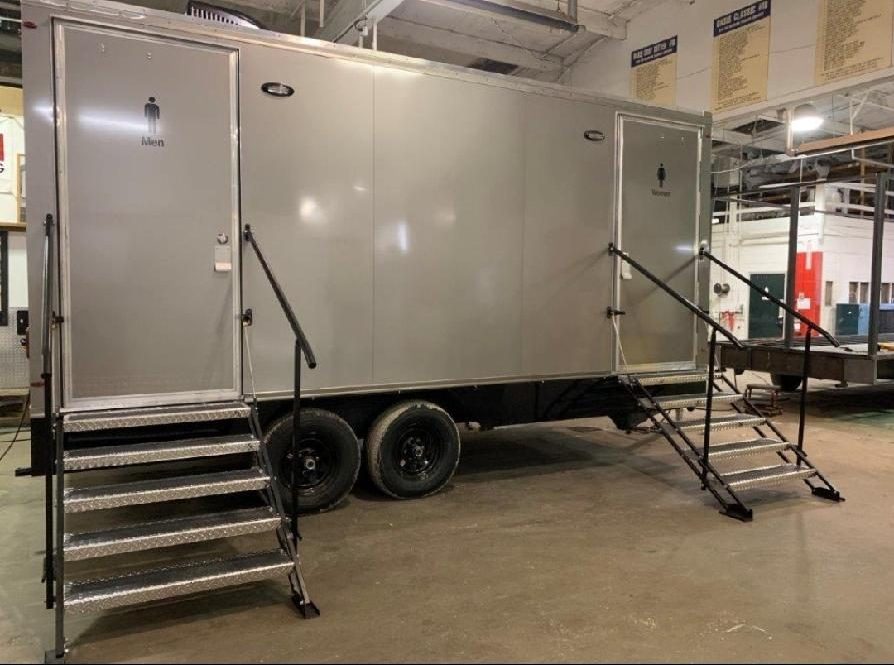
Standard trailer specs
Compare your options
Trailer, Standard Unit, or ADA. Which Fits Your Event?
The right choice depends on your guest count, site conditions, and whether the event calls for a restroom experience that matches the setting. This table covers the practical differences across all three options.
| Feature | Restroom Trailer | Standard Portable | ADA Unit |
|---|---|---|---|
| Guest experience | Flushing toilet, running water sink, mirror, climate control, interior lighting | Chemical tank, hand sanitizer dispenser, translucent roof panel for light | Chemical tank, hand sanitizer, wider door and turning radius for wheelchair access |
| Stall count per unit | 2 to 8 stalls in one trailer depending on configuration | 1 per unit, with multiple units clustered as needed | 1 per unit, ADA turning radius inside single stall |
| Power requirement | 30-amp or 50-amp generator or shore power required | None, fully self-contained, no power needed | None, fully self-contained, no power needed |
| Water supply | Onboard freshwater tank (125 to 200 gal.) or direct site hookup | None, hand sanitizer only, no running water | None, hand sanitizer only, no running water |
| Site footprint | 14 to 28 ft. trailer length plus tow vehicle clearance on delivery | Roughly 4 ft. x 4 ft. per unit, flexible placement | Roughly 5 ft. x 5 ft. per unit, requires level surface |
| Ground requirement | Level, firm surface. Gravel, asphalt, or packed turf minimum. | Generally tolerates slightly uneven ground | Level surface required for ADA compliance |
| Delivery access | Requires clear 12 ft. wide path and 14 ft. vertical clearance | Standard truck access, fits most standard site entrances | Standard truck access, same as standard portable |
| Typical events | Weddings, corporate receptions, golf tournaments, film productions | Construction sites, festivals, fairgrounds, outdoor concerts | Any event requiring ADA-compliant facilities, often alongside standard units |
| Service visit | Gray water pump, freshwater refill, restocking, scheduled per rental term | Tank pump and restock on weekly schedule | Tank pump and restock on weekly schedule |
| Setup time on-site | 45 to 90 minutes for leveling, hookup verification, and pre-use check | 15 to 30 minutes per cluster for delivery and placement | 15 to 30 minutes per unit including placement and level check |
Trailer availability varies by date. Contact us early for wedding and peak-season event dates. Trailers are often booked 4–8 weeks in advance.
Check AvailabilityBefore you book
What Your Site Needs Before the Trailer Arrives
Restroom trailers have specific requirements that standard portable toilets do not. Reviewing these before booking avoids complications on delivery day. Our team walks through all four points with you during the quote process.
Level, firm ground
The trailer must be positioned on a surface that is level within two inches across its full length. Gravel, asphalt, packed dirt, and level turf all work. Soft or wet ground can cause the trailer to settle unevenly after placement, which affects the flush mechanism and drain function. If the site has a slope, the driver will assess whether the placement area can be graded or blocked before unhitching.
- Level within 2 inches across full trailer length
- Gravel, asphalt, or firm packed turf acceptable
- Soft or waterlogged ground requires alternative placement
- Driver assesses and blocks as needed on arrival
Electrical power access
Restroom trailers require a 30-amp or 50-amp electrical service for climate control, lighting, and the water pump. If the venue has shore power available at the placement location, a standard outdoor extension cord rated for the amperage is sufficient. If no shore power is available, a generator is required. Generator rental is not included in the trailer rental rate and must be arranged separately. Confirm the amperage requirement with us when you book.
- 30-amp service for 2–4 stall configurations
- 50-amp service for 6–8 stall configurations
- Shore power or generator both acceptable
- Generator rental not included, arrange separately
- Confirm amperage at booking to avoid day-of gaps
Water supply options
Trailers carry a 125–200 gallon freshwater tank onboard, which is filled at the yard before delivery. For events lasting more than four hours with moderate traffic, that tank is typically sufficient for a single-day event without a site water connection. For multi-day events, a direct garden hose hookup to a site spigot will keep the freshwater supply continuous without requiring a service visit. If neither is available, a scheduled mid-event refill can be added to the order.
- Onboard 125–200 gallon freshwater tank filled at delivery
- Garden hose hookup extends capacity for multi-day events
- Site water connection requires standard 3/4-inch spigot
- Mid-event refill service available as an add-on
- Gray water holding tank emptied on each service visit
Delivery clearance
The delivery truck tows the trailer to the placement area and unhitches it in place. The truck and trailer combination requires a minimum 12-foot wide access path and 14-foot vertical clearance for overhead obstacles including low branches, power lines, and garage structures. The turning radius for a standard tow vehicle and trailer requires approximately 40–50 feet of maneuvering space at the placement site. If the venue has a gated entrance, confirm the gate width with us before booking.
- 12 ft. minimum clear width from entrance to placement area
- 14 ft. vertical clearance for overhead obstacles
- 40–50 ft. maneuvering radius at placement point
- Gate and entrance width confirmed before delivery day
- Placement area accessible without crossing soft turf where avoidable
Not sure if your site qualifies?
Call and describe the venue. We ask the right questions and tell you whether a trailer works or whether a cluster of standard units is the better fit for the location.
Pricing factors
What Goes Into the Quote
Restroom trailer pricing is not a flat rate. Four variables move the number: how long you need the unit, how many stations fit your headcount, how far the site is, and what utilities are available on location. Understanding these before you call means the quote you receive reflects the actual job.
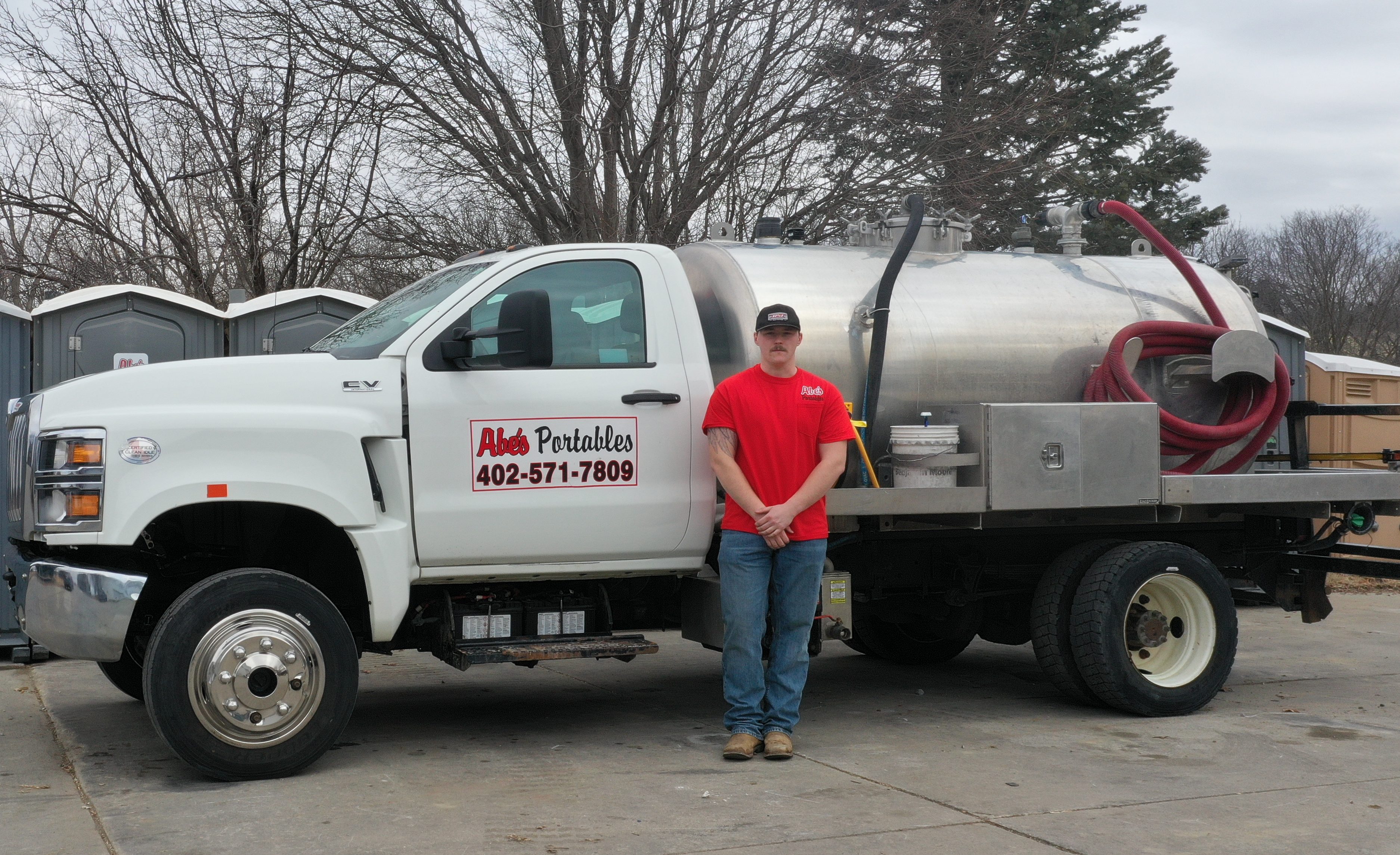
Omaha Metro Delivery
Event duration
A single-day wedding and a four-day corporate retreat use the same trailer but require different service schedules. One-day events are priced as a flat delivery-use-pickup package. Rentals running two or more days include at least one pump-out and freshwater refill per additional day, which adds to the base rate. For events longer than five days, weekly service pricing applies and is quoted separately. The day count runs from setup to pickup, not just the hours guests are on site.
Number of stations
A two-station trailer handles up to 100 guests comfortably for a four-hour event. A four-station trailer is appropriate for 200 to 250 guests. Larger guest counts or events with open bars typically need an additional unit or a higher station count to avoid queuing. When you request a quote, the station count is calculated based on your headcount, event type, and duration. Weddings typically need one station per 40 to 50 guests; construction site deployments are calculated differently based on worker count and shift length.
Delivery distance
The base rate covers delivery and pickup within a standard service radius from our Omaha yard. Sites in Bellevue, Papillion, La Vista, and most of Douglas and Sarpy counties fall within that radius. Sites in Lincoln, Council Bluffs, or farther out carry a mileage surcharge calculated at the time of quoting. The surcharge covers both the delivery trip and the pickup trip. For events more than 60 miles out, call to confirm availability before the event date, since distance affects scheduling and staffing for same-day or next-day setups.
Power and water setup
Restroom trailers require a 30-amp or 50-amp electrical connection to run the climate control, water pump, and lights. If your venue has shore power at the right amperage, connection is straightforward. If not, a generator is required. We can coordinate generator rental through a partner, or you can supply your own. The generator cost is not included in the trailer rental rate and should be budgeted separately. Water supply for the holding tank can come from an on-site spigot connection or from a fresh water delivery at setup. Sites without a spigot require the water delivery option, which adds a line item to the quote.
How it works
From Consultation to Removal
Site visit or phone consultation
The first step is a conversation about the event or project. For most weddings and corporate events, a phone consultation covers everything needed to build an accurate quote: headcount, event date, duration, venue address, and whether shore power and a water spigot are available on site. For larger productions, stadium events, or multi-day festivals, an in-person site visit lets the team walk the placement area, confirm clearances, and identify any access issues before delivery day. There is no charge for the site visit.
Most phone consultations take under 15 minutes.
Trailer selection and booking
Once the quote is accepted, we confirm the trailer configuration for your event. Options range from two-station units up to paired arrangements for larger headcounts. The trailer is held on the schedule with a deposit. At this stage you also confirm the setup location, utility connections, and any special requests, floral arrangements inside the trailer, a specific arrival window, that sort of thing. Weddings and corporate events with firm start times get a confirmed delivery window in writing. The remaining balance is due before or on delivery day.
A deposit holds your date, and the balance is due at or before setup.
Delivery and setup
The trailer arrives via a dedicated delivery vehicle with a driver qualified to back and level the unit on grass, gravel, asphalt, whatever the site has. Setup includes connecting to shore power or running the generator hookup, filling the freshwater holding tank, testing all fixtures, and confirming climate control is working before the driver leaves. Interior accessories such as soap dispensers, paper product dispensers, mirrors, and lighting are checked and stocked at this time. For weddings, the driver can coordinate with the venue coordinator on placement so the trailer sits in the agreed spot relative to the tent or ceremony area.
Setup typically takes 45 to 90 minutes depending on utility connections.
Event service
For events running more than one day, the service schedule is confirmed at booking. Service visits include pumping the waste holding tank, refilling fresh water, restocking paper products and soap, wiping down interior surfaces, and confirming all fixtures are operating correctly. For single-day events, a mid-event check can be added as an optional service call if the headcount is high or the event includes food and beverage service that typically increases restroom traffic. The service crew arrives in a clearly marked Abe's Portables truck and completes the service without interrupting guests.
Service visits are scheduled to avoid peak event hours when possible.
Removal
After the event ends or the rental period closes, the pickup crew retrieves the trailer during an agreed window. The crew disconnects utilities, pumps any remaining waste, and secures the unit for transport. Pickup is typically scheduled for the morning after an evening event. For multi-day rentals, pickup happens the day after the final event day unless an extended hold is arranged in advance. The site should be clear of vehicles and obstructions in the trailer's path to allow the pickup truck to access and remove the unit without assistance.
Pickup window confirmed before the event date.
FAQ
Before You Book
These are the questions couples, event planners, and corporate coordinators ask before confirming a trailer reservation. If yours is not here, call and we answer it directly.
(402) 571-7809Request a Quote